Security Licence: 000219491
Master Licence: 000107700
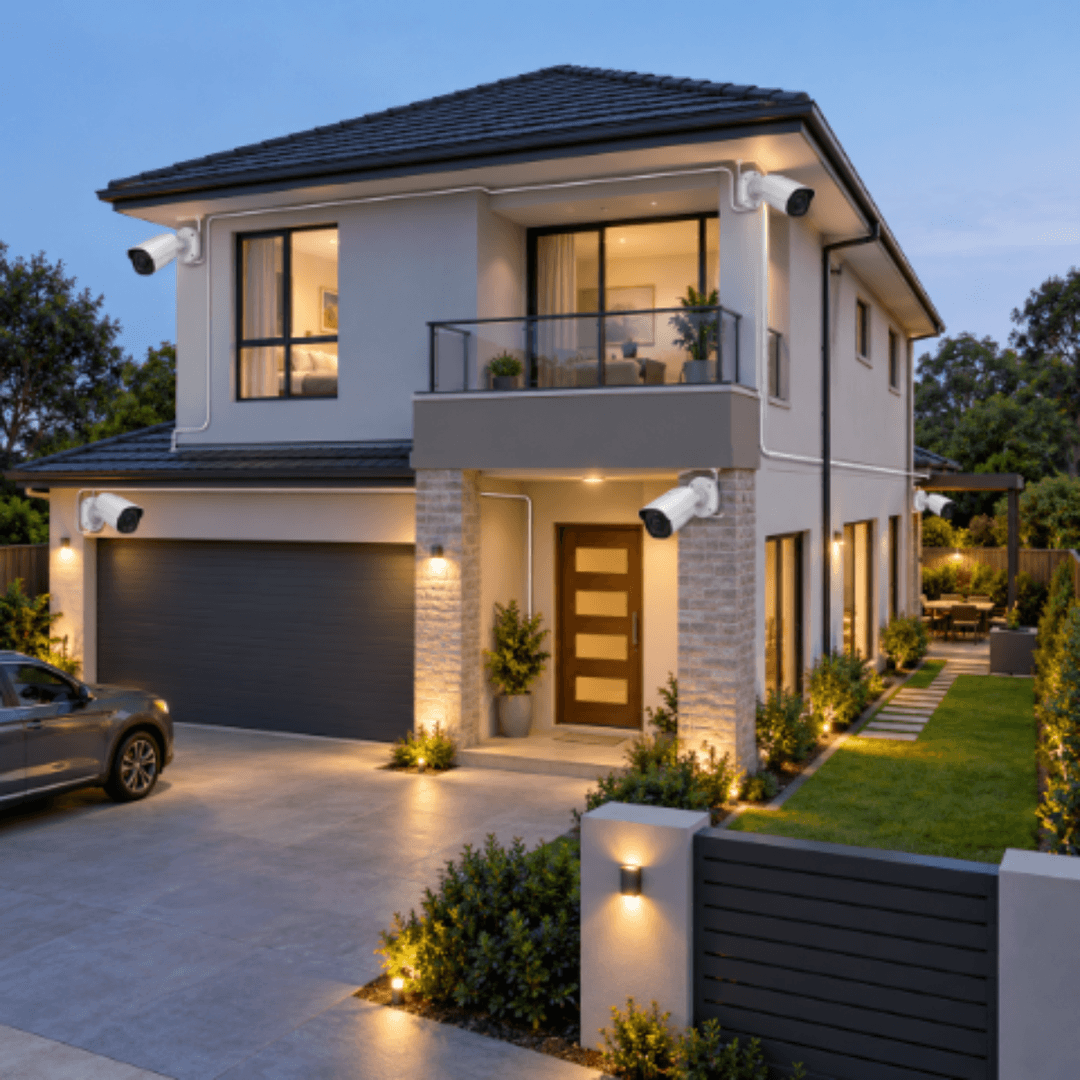
Choosing the right security system for a two-storey home requires more planning than protecting a smaller single-level property. With multiple floors, extra windows, side access points, balconies, garages, and outdoor areas, it is important to make sure there are no major blind spots.
For most two-storey homes, a wired or hybrid security camera system is usually the most practical option. It offers better coverage, reliable recording, and easier long-term management.
A two-storey property often has more areas that need monitoring. The front entrance may be easy to cover, but side paths, backyard doors, garages, balconies, and upper-level windows can sometimes be overlooked.
The goal is not simply to install more cameras. Each camera should be positioned to cover an important entry point or area of movement.
Common locations include:
Front door
Driveway
Garage
Side access
Backyard
Rear entrance
Balcony
Ground-floor windows
A well-planned layout can often provide better protection with fewer cameras than a poorly designed system with unnecessary coverage.
For homeowners who plan to stay in the property long term, wired security cameras are often the better choice.
Modern PoE cameras use Ethernet cables that carry both power and data. This gives each camera a stable connection and reduces dependence on Wi-Fi.
A wired system is particularly useful when several cameras need to record continuously. Footage can be stored on an NVR inside the property, allowing you to review recordings even if the internet connection becomes unstable.
The main disadvantage is installation. Running cables through a two-storey home can require roof access, wall cavities, or professional cabling. However, once installed correctly, the system usually requires very little ongoing maintenance.
Wireless cameras are still useful in certain areas where running cables is difficult.
For example, a Wi-Fi video doorbell may be convenient at the front entrance, while a battery-powered camera could cover a location that is hard to reach with Ethernet cabling.
However, Wi-Fi strength needs to be checked carefully. Cameras installed upstairs, near the garage, or around the backyard may be far from the router.
Walls, floors, distance, and other devices can all affect wireless camera performance.
A hybrid system combines wired and wireless cameras.
This can work particularly well in a two-storey home. Wired cameras can protect important outdoor areas such as the driveway, garage, side access, and backyard, while wireless devices can be used at locations where permanent cabling is inconvenient.
This approach gives you reliability without forcing cables into every part of the property.
There is no fixed number of cameras that suits every property.
A smaller two-storey home may only need four cameras, while a larger property may require six, eight, or more.
The correct number depends on:
Property size
Number of entrances
Garage location
Side access
Backyard layout
Existing fences and gates
Camera viewing angles
For most two-storey homes, a wired PoE security system with an NVR provides the best combination of reliability, continuous recording, and long-term convenience.
Wireless cameras are useful where cabling is difficult, while a hybrid setup can provide flexibility in selected areas.
The best security system is not necessarily the one with the most cameras. It is the one that covers the important access points, reduces blind spots, and works reliably across the entire property.